How Kernaut works
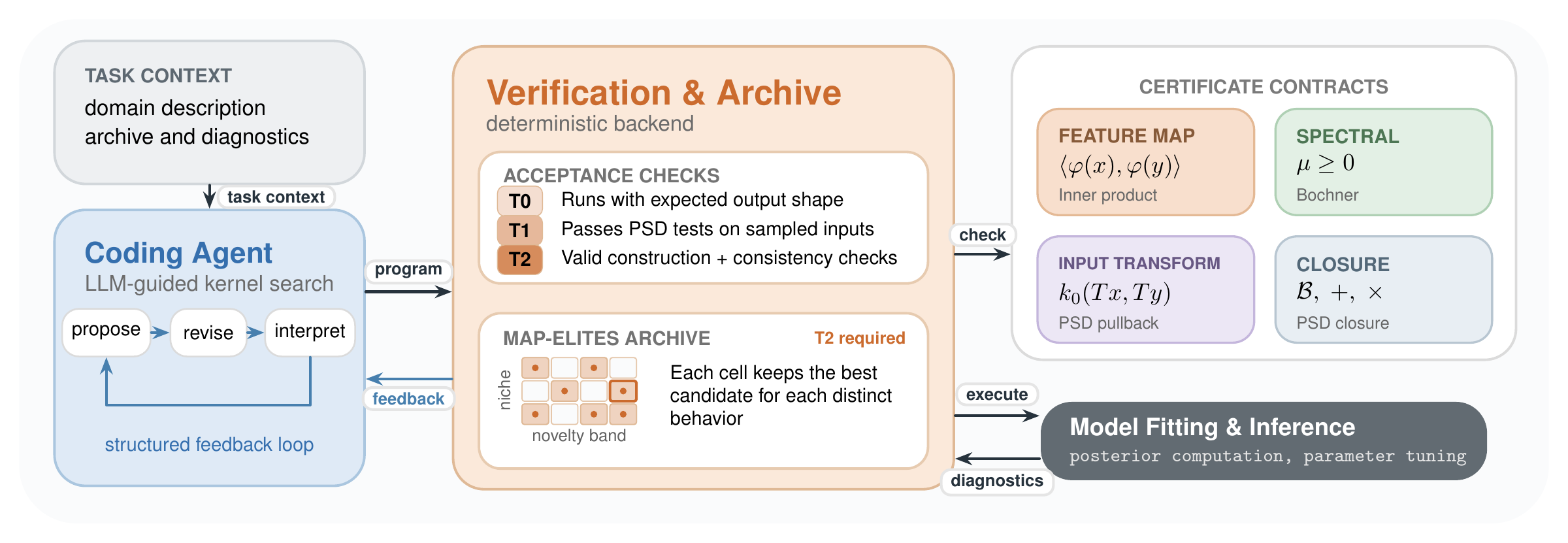
Kernaut searches for reusable kernels through four steps:
- Propose. A coding agent writes kernel components, such as feature maps or input transforms.
- Verify. A trusted backend assembles the components using construction rules that preserve kernel validity under stated assumptions.
- Evaluate and refine. The system scores candidates and keeps strong kernels with distinct behaviors in an archive. Agents use these results to guide further proposals.
- Test transfer. Validation selects a frozen kernel, which is then evaluated on tasks the search never saw.
Read the verification guide for construction contracts and checks, and the meta-evaluation protocol for task splits and candidate selection.
Example discovery: the DWF kernel
An agent discovered the dual warp-fold (DWF) kernel on the black-box optimization benchmark. DWF combines a gentle warp with a triangular fold of each input coordinate. The fold maps mirrored inputs to the same feature value, while the warp keeps them distinguishable.
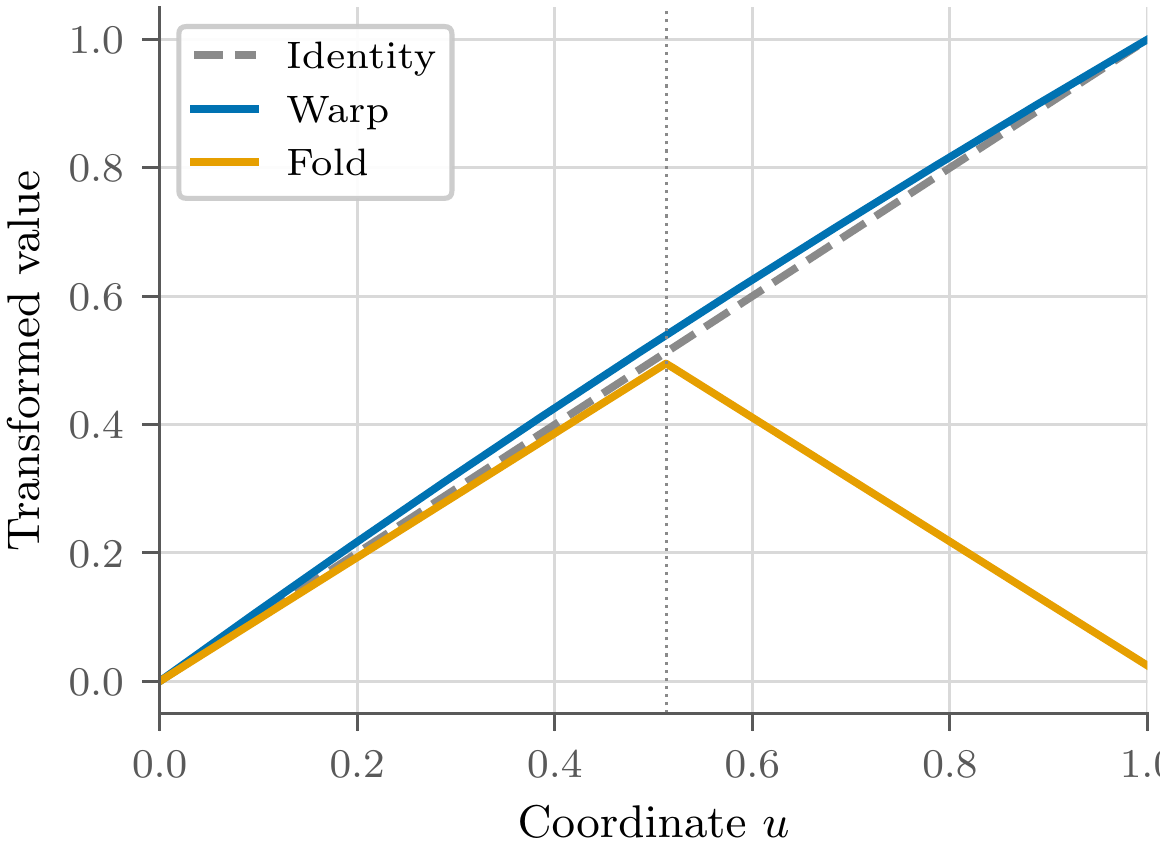
The gentle warp and triangular fold used by DWF.
DWF applies a Matérn-5/2 kernel to this discovered representation, so similarity depends on input location as well as distance. This makes it nonstationary, unlike a standard Matérn kernel. Sums and products of standard stationary kernels cannot recover this structure.
Because the discovered kernel programs are short and interpretable, they invite human–AI collaboration: researchers can understand the agent's proposal and refine its assumptions. For DWF, we separated the warp and fold into additive kernel components, strengthening the connection between mirrored inputs. This human-refined version reduced held-out predictive error by a further 5.7%, showing how an agent's discovery can become a starting point for further model design.
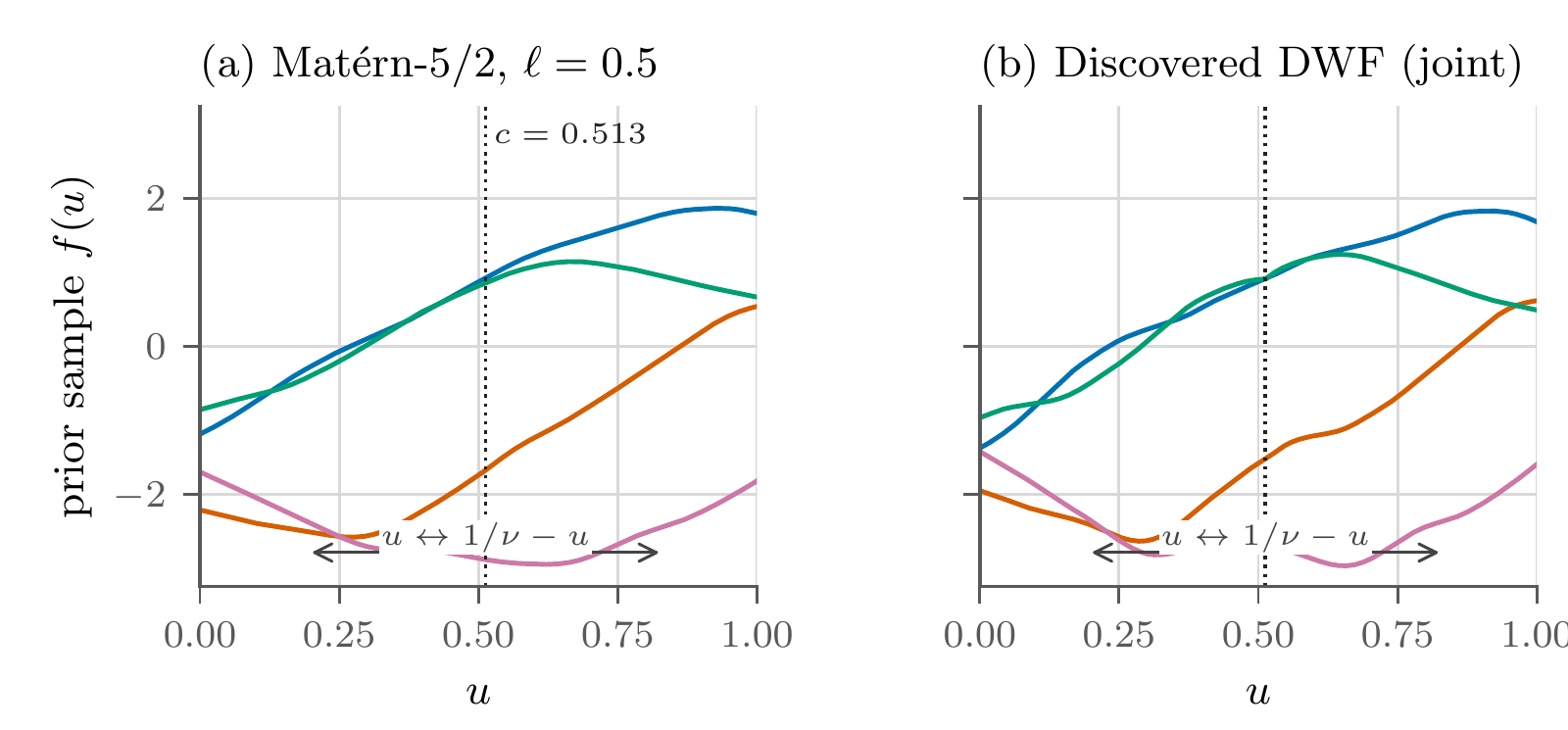
Functions sampled before fitting data: (a) Matérn-5/2 and (b) DWF. DWF samples have visible corners at the fold.
Try the black-box optimization benchmark, or read the paper for the full analysis.