Richard Cornelius Suwandi
AI PhD Candidate at CUHK-Shenzhen, Co-founder of AIDDA Institute

Community
-
 Qwen (Alibaba Cloud) Dev ambassador
 -
 AIXI Labs Community member
 -
 alphaXiv Former AI4Science community lead
I’m a PhD candidate at the School of Artificial Intelligence, CUHK-Shenzhen, advised by Prof. Feng Yin and Prof. Tsung-Hui Chang. My research develops adaptive inductive biases for data-efficient optimization and discovery. I also co-founded the Institute for AI-Driven Discovery of Algorithms (AIDDA), a community and research network for AI-driven research systems.
Background
-
 2026ByteDance (Douyin) Research Scientist InternGenerative recommendation and LLM4Rec
 -
 2025Dria Research Scientist InternEvolutionary coding agents for algorithm discovery and codebase optimization
 -
 2025Huawei Research Engineer InternScalable black-box optimization for 5G systems
 -
 2021Shenzhen Research Institute of Big Data (SRIBD) Undergraduate Research AssistantFederated matrix factorization for large-scale recommender systems
 -
 2019-2023CUHK-Shenzhen B.Sc. in Statistics (with concentration in Data-Science)Graduated with first-class honors, and got into ML/AI research
Questions I'm thinking about
How can models adapt their assumptions to the task when data and evaluations are limited?
How can AI agents discover new algorithms and models that we can verify?
How do we evaluate AI research systems on real problems and improve them from feedback?
If you want to talk about research or collaborations, feel free to reach out.
News
Research
-
TL;DR
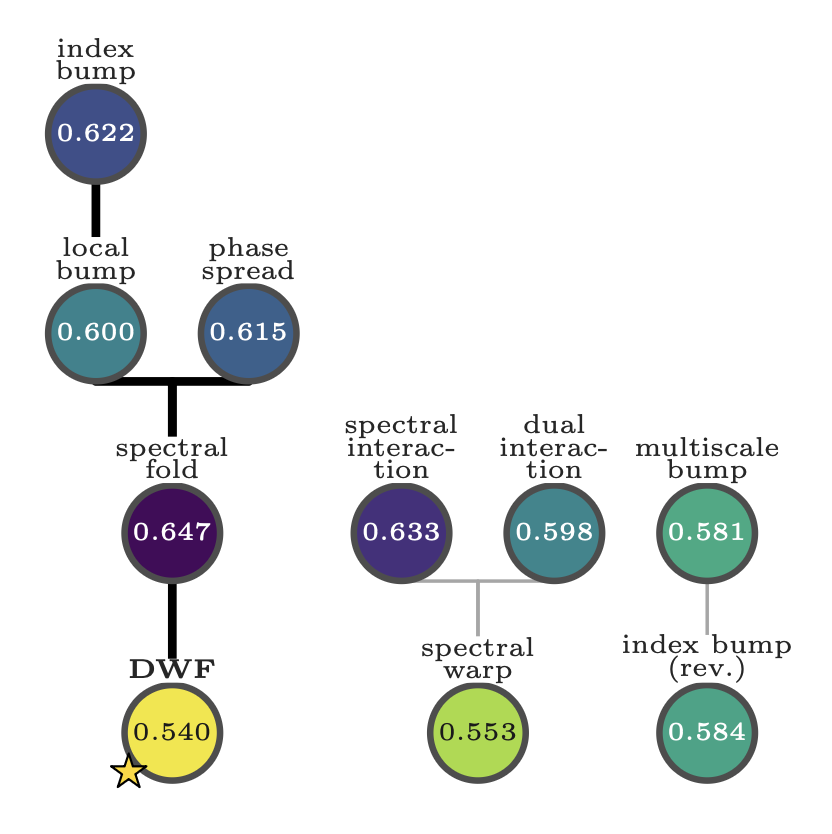
We introduce Kernel Autoresearch (Kernaut), which uses coding agents and validity-preserving construction contracts to discover reusable kernel programs. The kernels transfer to unseen optimization functions, enzyme mechanisms, time series, and simulated glucose patients without further LLM calls.
Abstract
Kernels encode the inductive bias of a wide range of machine learning models, yet automated kernel design faces a fundamental dilemma. A fixed grammar of base kernels and operators guarantees validity but limits the search to structures expressible by those building blocks. Conversely, unrestricted programs remove this limitation but no longer guarantee validity. In our stress tests, 22–58% of LLM-generated kernels that pass numerical checks on random inputs fail when evaluated at different scales or dimensions. We propose Kernel Autoresearch (Kernaut), which treats kernel design as open-ended model discovery. Coding agents write kernels as programs, while construction contracts ensure that every accepted kernel is valid. A quality-diversity archive retains high-performing kernels with distinct behaviors, and novelty screening steers agents toward functionally new candidates. Our experiments demonstrate that the discovered kernels encode reusable inductive biases that generalize to unseen tasks. On held-out black-box optimization families, a discovered kernel outperforms a meta-learned deep kernel trained on the same episodes. Furthermore, kernels discovered from ten enzyme-kinetic rate laws achieve lower error than tuned ARD and deep kernel baselines on five unseen mechanisms. The discovered kernels are also interpretable programs that human researchers can refine: a human-refined version of one further reduces the held-out predictive error by 5.7% and optimization regret by 7.8%.
@misc{suwandi2026kernaut,
  title = {Kernel Autoresearch for Open-Ended Model Discovery},
  author = {Suwandi, Richard Cornelius and Yin, Feng and Murphy, Kevin},
  year = {2026},
  eprint = {2610.10394},
  archivePrefix = {arXiv},
  primaryClass = {cs.LG},
}

-
Adaptive Kernel Design for Bayesian Optimization Is a Piece of CAKE with LLMs
39th Conference on Neural Information Processing Systems (NeurIPS) 2025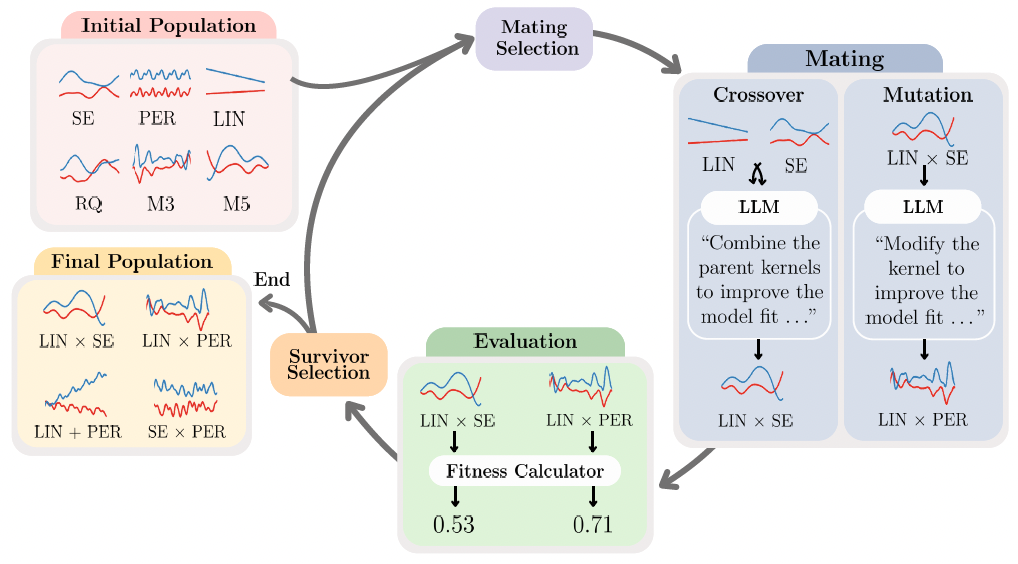
TL;DR
A poorly chosen GP kernel slows Bayesian optimization. CAKE uses an LLM to evolve kernels during the search, and BAKER picks which one to query next, improving hyperparameter optimization, controller tuning, and photonic chip design.
Abstract
The efficiency of Bayesian optimization (BO) relies heavily on the choice of the Gaussian process (GP) kernel, which plays a central role in balancing exploration and exploitation under limited evaluation budgets. Traditional BO methods often rely on fixed or heuristic kernel selection strategies, which can result in slow convergence or suboptimal solutions when the chosen kernel is poorly suited to the underlying objective function. To address this limitation, we propose a freshly-baked Context-Aware Kernel Evolution (CAKE) to enhance BO with large language models (LLMs). Concretely, CAKE leverages LLMs as the crossover and mutation operators to adaptively generate and refine GP kernels based on the observed data throughout the optimization process. To maximize the power of CAKE, we further propose BIC-Acquisition Kernel Ranking (BAKER) to select the most effective kernel through balancing the model fit measured by the Bayesian information criterion (BIC) with the expected improvement at each iteration of BO. Extensive experiments demonstrate that our fresh CAKE-based BO method consistently outperforms established baselines across a range of real-world tasks, including hyperparameter optimization, controller tuning, and photonic chip design. Our code is publicly available at https://github.com/richardcsuwandi/cake.
Open Question
CAKE adaptively rewrites the kernel during the search, so the surrogate itself changes as data arrive. Classical regret analysis assumes a fixed function class, so deriving bounds when the kernel evolves every round remains open.
@article{suwandi2025cake,
  title = {Adaptive Kernel Design for Bayesian Optimization Is a Piece of CAKE with LLMs},
  author = {Suwandi, Richard Cornelius and Yin, Feng and Wang, Juntao and Li, Renjie and Chang, Tsung-Hui and Theodoridis, Sergios},
  journal = {39th Conference on Neural Information Processing Systems (NeurIPS)},
  year = {2025},
}

-
Breaking the Curse of Dimensionality in Gaussian Process Training With Zeroth-Order Adaptive Perturbation
ORAL 51th IEEE International Conference on Acoustics, Speech and Signal Processing (ICASSP) 2026TL;DR
Training a Gaussian process gets expensive as the number of hyperparameters grows. ZAP estimates the full gradient from two loss evaluations, independent of dimension, with about 20x lower error and 118x less optimization time.
Abstract
Hyperparameter optimization remains a core challenge in training Gaussian processes (GPs), primarily due to the high computational cost and numerical instabilities associated with gradient-based optimizers. These issues are exacerbated in high-dimensional spaces, where the optimization landscapes become increasingly complex and difficult to navigate efficiently. We propose zeroth-order adaptive perturbation (ZAP), a scalable gradient-free algorithm that leverages simultaneous perturbations sampled from a Bernoulli distribution to obtain accurate gradient estimates with only two function evaluations per iteration, regardless of the hyperparameter dimensionality. Our theoretical analysis establishes that the gradient estimator is asymptotically unbiased and that ZAP converges to a stationary point under standard assumptions. Empirically, ZAP outperforms state-of-the-art gradient-based and gradient-free baselines on real-world datasets, achieving an average of 20 times reduction in mean-squared-error and a 118 times speedup in optimization time.
Open Question
Two simultaneous Bernoulli probes recover the full hyperparameter gradient from two loss evaluations, independent of how many kernel parameters there are, whereas finite differences would need two evaluations per parameter. ZAP shows that this two-point estimator is asymptotically unbiased and that the iterates reach a stationary point of the GP marginal likelihood, so deriving a finite-sample error bound for the estimator, and a convergence rate for the hyperparameters, remains open.
@inproceedings{suwandi2026breaking,
  title = {Breaking the Curse of Dimensionality in Gaussian Process Training With Zeroth-Order Adaptive Perturbation},
  author = {Suwandi, Richard Cornelius and Yin, Feng and Chang, Tsung-Hui},
  booktitle = {51th IEEE International Conference on Acoustics, Speech and Signal Processing (ICASSP)},
  year = {2026},
  organization = {IEEE},
}

-
GRAPE: Gradient Refinement and Progress-Aware Exploitation for Query-Efficient High-Dimensional Bayesian Optimization
PREPRINT 2026TL;DR
Local Bayesian optimization often takes tiny steps that are almost sure to descend. GRAPE first sharpens the local gradient, then moves in the direction with the largest expected decrease, giving a 5.4x speedup on adversarial attacks and 3.8 log-units better regret on LLM prompt optimization.
Abstract
Optimizing expensive, high-dimensional black-box functions remains a central challenge in modern machine learning and scientific discovery. While local Bayesian optimization mitigates the curse of dimensionality, existing techniques often prioritize the probability of descent over the magnitude of progress. This leads to overly conservative steps that yield negligible improvement, wasting queries on directions that are nearly certain to descend but offer little decrease. We introduce Gradient Refinement and Progress-Aware Exploitation (GRAPE), a two-stage framework that first sharpens the local gradient posterior via a closed-form acquisition function, then selects update directions by maximizing the expected decrease conditional on descent. Theoretical analysis proves that this gradient refinement stage monotonically minimizes local uncertainty and that the progress-aware direction converges to true steepest descent as the posterior sharpens. Empirically, GRAPE demonstrates superior query efficiency across high-dimensional tasks: in black-box adversarial attacks, it achieves an average 5.4× speedup over baselines, and on large language model prompt optimization tasks, it outperforms the second best method by a reduction of 3.8 log-units in the final average regret.
Open Question
Local BO often takes steps that are almost sure to descend even when the drop is tiny, so GRAPE first sharpens the local gradient and then moves in the direction with the largest expected decrease. Classical analyses track the chance of descent, so deriving how fast those sharpened steps compound, and a rate of convergence for the overall search, remains open.
@misc{suwandi2026grape,
  title = {GRAPE: Gradient Refinement and Progress-Aware Exploitation for Query-Efficient High-Dimensional Bayesian Optimization},
  author = {Suwandi, Richard Cornelius and Yin, Feng},
  year = {2026},
  eprint = {2608.25116},
  archivePrefix = {arXiv},
  primaryClass = {cs.LG},
}
-
TL;DR
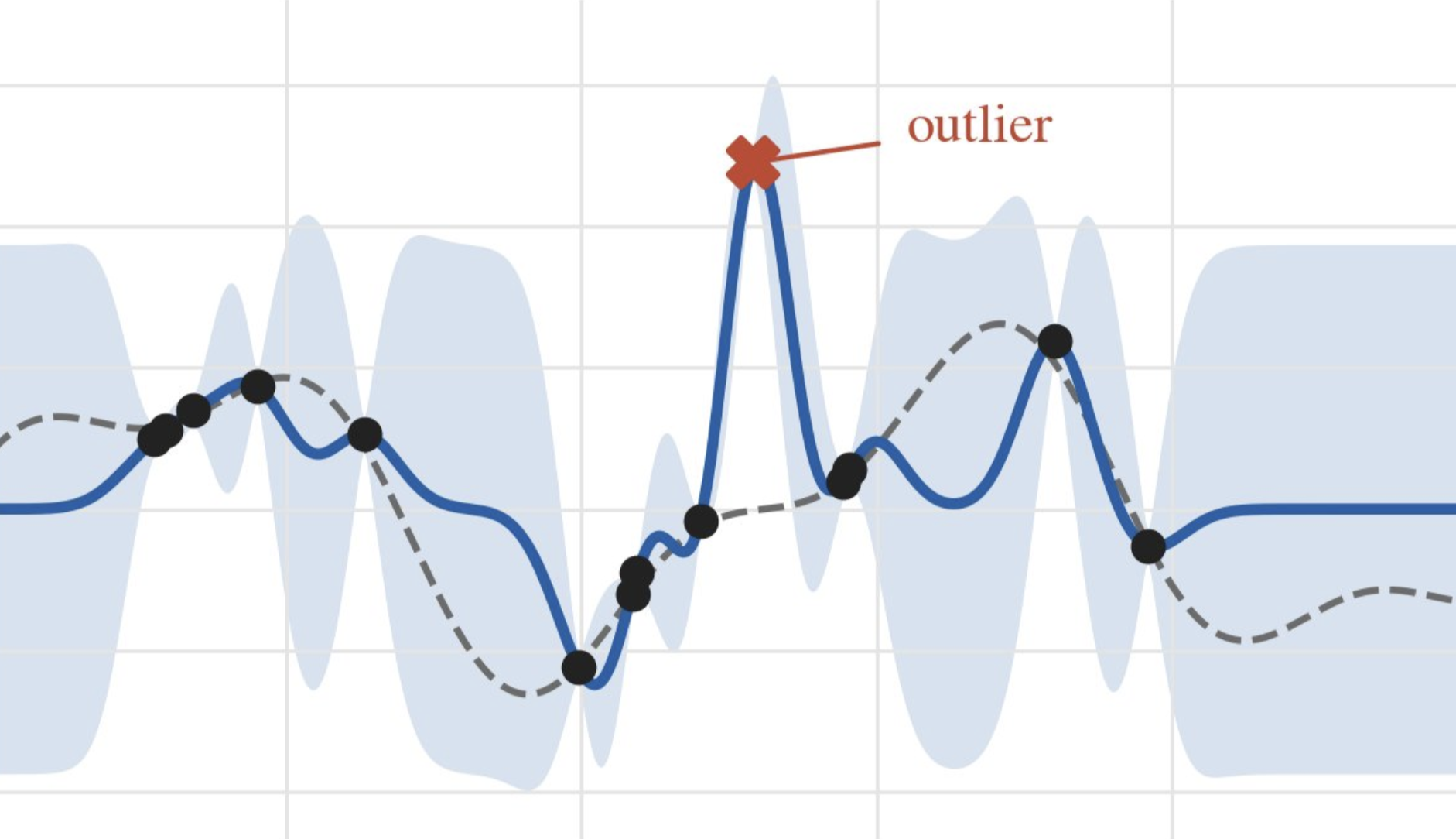
Standard Bayesian optimization is brittle when a single corrupted evaluation can shift the Gaussian process posterior and send the search the wrong way. q-ED-BO keeps that posterior’s closed-form mean and variance, and replaces the Gaussian predictive with a q-exponential whose shape q sets the tail, recovering the GP at q = 2. On beamformer and adaptive-filter tuning it matches the baselines on clean data, and under impulsive outliers it improves the strongest baseline by about 0.7 dB in output SINR and 1.1 to 1.2 dB in misalignment reduction.
Abstract
Bayesian optimization (BO) is a widely used framework for optimizing expensive black-box objectives, but standard BO methods often use Gaussian process (GP) surrogates whose Gaussian assumption is sensitive to outliers and heavy-tailed noise. We introduce q-ED-BO, a robust BO method whose surrogate follows a univariate q-exponential (q-ED) distribution, preserving GP-BO’s closed-form posterior mean and variance while a shape parameter q controls the tail behavior, recovering the GP at q = 2 and growing heavier-tailed with wider confidence bounds as q decreases. This tractability yields a closed-form q-upper confidence bound (q-UCB) with sublinear regret, and an exact closed-form q-expected improvement (q-EI) that generalizes EI to the heavy-tailed predictive, recovering classical EI at q = 2. Experiments on beamformer and adaptive filter tuning with impulsive outliers show that q-ED-BO matches or exceeds existing baselines on clean data, and under corruption, improves the strongest baseline by approximately 0.7 dB in output SINR and 1.1 to 1.2 dB in misalignment reduction.
Open Question
The shape q is fixed before the search, and q-EI is available in closed form but has no regret guarantee, so learning q from the data, and a convergence rate for q-EI, remain open.
@misc{suwandi2026qed,
  title = {Robust Bayesian Optimization with Q-Exponential Surrogates},
  author = {Suwandi, Richard Cornelius and Lin, Zhidi and Yin, Feng and Zoubir, Abdelhak M.},
  year = {2026},
  eprint = {2609.32775},
  archivePrefix = {arXiv},
  primaryClass = {cs.LG},
}